Showing posts with label Epson R-D1. Show all posts

Friday, October 29, 2010

The colour and the shape

Three cities, three cameras, three photographs.


Hamburg, 2009 - Epson R-D1, 1/450, ISO400


Paris, 2010 - Leica M8, 1/360, ISO160


Tampere, 2010 - Kodak BW400CN

Friday, October 8, 2010

Markets, street vendors

Markets are often great places for street photography. Or is that market photography then? Anyway, with people interacting with each other and going on about their business, the photographer is often ignored. The markets are also full of colour and interesting shapes. Sometimes too full which easily makes photographs too cluttered if you don't simplify them enough. Often you however don't have the choice if you really want the shot. It's also worth hanging around street vendors. They are basically small, simple markets, which helps remove some of the movement and clutter while providing good opportunities for interesting photographs.


Paris, 2010 - Leica M8, 1/125, ISO 160


Helsinki, 2009 - Epson R-D1, 1/2000, ISO 200


Tampere, 2009 - Epson R-D1, 1/450, ISO 400


Sometimes it's the advertising that catches your eye:


Tokyo, 2010 - Leica M8, 1/125, ISO 320


The Leica M8 photos were taken with the Voigtländer 15/4.5 Super Wide Heliar and the Voigtländer 35/1.4 Nokton SC, respectively. The Epson R-D1 photos, on the other hand, were with the Leica Summicron-M 50/2 and the Voigtländer 35/1.4 Nokton SC.

Wednesday, September 22, 2010

Windows in photographs

I often find myself photographing windows and doors. They are the kind of architectural details you will find practically everywhere with many details of their own: locks, knobs, decorations. They also bring a strong human element to photographs with people looking from windows deep in thought or hurriedly coming and going through doorways. Windows and doorways make simple frames and provide lighting. They can essentially be the subject, frame the subject, or light it. And they are everywhere around us in the urban environment providing endless possibilities for interesting photographs. Actually, I think I don't find myself photographing windows and doors anywhere as often as I probably should.

Here are some photographs with windows I chose for this post. The first two pictures feature a window as the main subject. The first one is really about the humorous balance between two halves of the window: one side advertising the store with the text "now open" while the other side suggests the store is under renovation. The second photograph features a window in a lighthouse.


2007 - Canon EOS-300D, 1/125, f/8, ISO 200


2009 - Sigma DP1, 1/200, f/8, ISO 100


In the next two shots the window acts as a frame. The first of the two I took in the same lighthouse as the previous photograph.


2009 - Epson R-D1, 1/2000, ISO 200


2009 - Canon EOS-1D, 1/3200, ISO 250


In this next photograph I really liked the window frame. However, with its nasty reflections the window alone does not make for a very pleasant subject. The man sitting on the bench gives it both a context and scale.


2009 - Sigma DP1, 1/500, f/5.6, ISO 400


The last image features an open window, which breaks the pattern or repetition of closed windows. Emphasis is given to the open window by using a tilted lens (essentially this just gives a very shallow depth of field in this example).


2009 - Canon EOS-1D, 1/8000, ISO 320


I used a Carl Zeiss Jena 80/2.8 lens on 1D, a Sigma DC 18-50/3.5-5.6 lens on 300D, and Leica Summicron-M 50/2 on R-D1 for these photographs. The 80/2.8 lens was used with a tilt adapter.

Saturday, August 28, 2010

Pictures from Paris

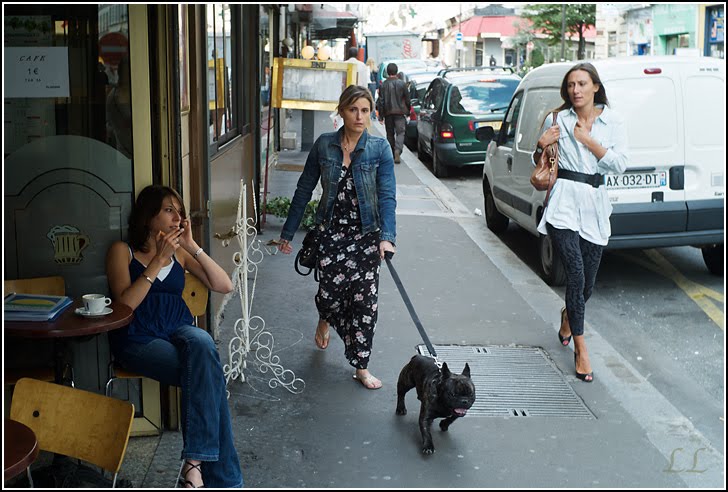
It has been a couple of weeks since my last post, so let's follow up with some recent photographs. These pictures are from Paris. There is no central theme covering them all, but each three sets of two photographs have something in common: street scenes, kids reacting to their surroundings, and people sleeping. Enjoy!


Paris, 2010 - Leica M8, 1/125, ISO 160


Paris, 2010 - Leica M8, 1/250, ISO 320


Paris, 2010 - Leica M8, 1/180, ISO 160


Paris, 2010 - Epson R-D1, 1/450, ISO 400


Paris, 2010 - Leica M8, 1/500, ISO 160


Paris, 2010 - Epson R-D1, 1/600, ISO 200


All these pictures are pretty much uncropped except for the one of the boy chasing the pigeon, which I found best to crop to a square format. The lens I used for all the Leica M8 pictures is the Voigtländer 35/1.4 Nokton SC, while both Epson images were taken with a Leica Summicron-M 50/2 lens. These focal lengths correspond to about 45 mm or 50 mm for the M8 and 75 mm for the Epson in 35-mm equivalent terms.

By the way, the Epson re-covering job mentioned in a past post is still upcoming and definitely not forgotten.

Friday, July 2, 2010

Experimenting with the Bug

Last time I wrote about getting two soft releases for my rangefinder cameras. I have now run some Bug experiments. This means using the Bug soft release on my Epson R-D1 in my everyday photography. I haven't really done any low-light shooting and therefore haven't faced slow shutter speeds. So, the added stability is still a bit of a mystery. The overall feel of the camera and the control of the point of releasing the shutter is improved, though. That alone is worth the price, should I find there is no other benefit in the end. Well, there actually is at least one other benefit. Shooting with gloves was never this easy! It will be a couple of months before I will consider wearing gloves, but I just had to quickly try on a pair when the idea came to me. Wearing gloves in July obviously isn't too comfortable!

I browsed through some of my photographs looking for ones that show the kind of motion blur I'm trying to fight with the Bug. There were some so-so ones. I think I have culled most of those that don't work with a bit of camera shake thrown in. Here's anyway one shot I came across. Not a good example of anything I have discussed so far really, but a nice shot demonstrating another source of shakiness: a moment that is a bit too fast or otherwise takes you by surprise forcing you to trigger the shutter while in motion.


Woman in Hamburg, 2009 - Epson R-D1, 1/100, ISO 400

This shot doesn't appear too soft at this size, but there is some motion blur in it. I was standing there by the Hamburg Philharmonic Hall Pavilion all by myself, facing the other way. As I turned around to look for a shot, this lady who had just appeared from somewhere without me noticing her was stepping to the horn. I barely had time to check my pre-focus for this shot. As she leant in to listen to the sounds from the horn, I quickly brought the camera to my eye and saw the expression I had anticipated. Preferring the moment over the technical merit of the shot, I took it without steadying my camera. She noticed me only the very moment I had my camera to my eye and made the photograph, which shows through as faint surprise mixed with curiousness in her expression.

Shot at 1/100 this photo is far from a slow shutter speed image where the soft release should help the most. Based on my experience over these couple of days, I think it could however help a bit with shots like these as well. Even if only by making one more confident with one's camera.

Monday, June 28, 2010

First things first

What better way to start a week than receiving something cool in the mail. And what better way to start enjoying what you just received than starting a blog about it. Well, this blog isn't really about a soft release, or even two of them. That's just what I happened to receive today. However, they are the topic of this first blog post for that very reason. Let's first discuss what soft releases are, what they are supposed to do, and then take a look at the ones I now have.

A soft release is a little button you can screw into the shutter release on many cameras. It basically makes the shutter release a bit easier to reach (by making it bigger and providing a different shape) and a bit easier to trigger (hence the term, soft release). The idea behind this is to reduce effects of camera shake on your pictures by eliminating some of the shake from the photographer pushing the shutter button. Not all cameras can fit a soft release. For example, a Canon DSLR will not have place for one, while a Leica M will. While some SLRs can fit a soft release, I would expect rangefinders and other mirrorless cameras to benefit more from using them. This is because the mirror slap of an SLR camera also introduces some shake and this cannot be removed with such a simple accessory. Better handholding technique is of course beneficial in both cases, and I guess some may even think a soft release is just an attempt to take a shortcut there. As I have not tried one before this day, I cannot yet really comment on that point.

Here are my two ladybugs with threads on their bottoms:


They are made by match Technical Services, who specialize in photographic accessories for the Leica M rangefinder cameras. Among other things, they make several types of soft releases. The ones with the ladybug paint job are called Bugs. Now, in addition to looking cool (or not like your typical camera accessories anyway) these things are actually very well made. They are CNC machined out of solid brass, and my first impression when putting one on my Epson R-D1 digital rangefinder camera was very positive. They fit the thread perfectly and require just the right amount of force to take off. You will not lose these things easily by accidentally dropping one off the camera, they won't break nor should they get stuck on your camera. Nice.

As I received two Bugs (red and white), I was able to compare their quality, finish, and functionality. I'm very pleased with them both and there are no differences between them except for one thing. You will notice in the image below that the ladybugs are not facing the same way when attached on the camera. Oh the horror! This is due to both the Bugs themselves as well as the camera. Firstly, the Bugs are obviously unique. It would perhaps be possible to align the soft releases better for the painting. However, the threads on the cameras differ as well and the maker of the soft releases has zero control over that, so there would be very little point to do so. For example, my Voigtländer Bessa rangefinder camera had the Bugs facing in yet another directions. No biggie, but someone may care. If this would bother you and you want to try a soft release, get a design that you feel comfortable having any which way on your camera.


So, are all my photos now shake-free and can I suddenly handhold shots a stop slower? No, and I don't know. I need to experiment more. I do believe it should be possible to use at least slightly longer shutter speeds now, since firing off shots only requires a fairly gentle tap with the soft release. The difference is noticeable. And the ladybugs are simply pretty cute. While the white one looks good on the R-D1, I'm not picking any favourites yet.

This concludes my first post. More will follow. This is my soft release into blogging.